The Supreme Court’s recent examination of medicine pricing has brought renewed attention to excessive trade margins, hospital pharmacy markups and the limits of India’s drug-price control regime. The Government’s latest intervention concerning 137 anti-cancer drugs offers a significant, but not complete, response to the affordability challenge.
INTRODUCTION-
In the first part of my blog, I highlighted certain strategic business practices and arrangements peculiar to the pharmaceutical sector, identified in the Competition Commission of India’s (CCI/Commission) 2021 Market Study on the Pharmaceutical Sector, as well as some prevailing and well-known unethical practices in India’s healthcare system. In my view, these are matters that ought to have attracted closer scrutiny by the CCI, but have not received adequate enforcement attention so far.
In this concluding second part, I analyse the issues raised in the pending public interest litigations (PILs) before the Supreme Court of India concerning excessive medicine prices, the Government’s recent initiative through the National Pharmaceutical Pricing Authority (NPPA) to rationalise trade margins for 137 identified non-scheduled anti-cancer drugs, and some gaps in the wider debate which, hopefully, may receive attention in future proceedings.
Can medicines indispensable to human life be treated as ordinary commercial products, with their prices left substantially to market forces? How should the law reconcile the pharmaceutical industry’s legitimate commercial interests with the constitutional and public-health imperative of making essential medicines affordable?
These questions came sharply into focus during hearings before the Supreme Court of India in Kishan Chand Jain v. Ethics and Medical Registration Board, W.P. (C) No. 794/2023, heard alongside Dr. Sanjay Kulshresthra v. Union of India, W.P. (C) No. 717/2026. Its scrutiny of the substantial differences between medicine procurement prices and the maximum retail prices (MRPs) charged to patients has brought India’s pharmaceutical pricing framework under renewed examination.
On 27 October 2026, the Supreme Court has reserved its order after hearing the parties. The judgment is awaited.
Meanwhile, the NPPA, the drug-pricing regulator under the Department of Pharmaceuticals, announced trade-margin rationalisation for 137 identified non-scheduled anti-cancer drugs, with revised prices taking effect on 9 November 2026. The Government’s official announcement attributes this measure to recommendations of an expert committee constituted by the Directorate General of Health Services and invokes paragraph 19 of the Drugs (Prices Control) Order, 2013 (DPCO). It would therefore be inaccurate to describe it as a price cap imposed by the Supreme Court. The measure was, however, undertaken against the background of the Court’s scrutiny of medicine pricing.
Be that as it may, the Government’s intervention is significant and pro-consumer, though belated. It illustrates how existing statutory powers can be used to address excessive trade margins while broader questions concerning drug-price regulation remain before the Supreme Court.
1. The controversy: when procurement prices and MRPs diverge
One of the central concerns raised during the Supreme Court proceedings was the disparity between the price paid by a retailer or distributor to procure a medicine and the MRP ultimately charged to a patient.
The Court was informed of an instance involving a cancer-treatment injection reportedly available to a dealer for approximately ₹11,000 but charged by a hospital at ₹1.3 lakh. Another example involved a cancer medicine with an MRP of approximately ₹27,000 against a reported retailer procurement price of around ₹2,700.
These examples prompted questions about the justification for substantial markups, particularly where patients may have little practical ability to defer treatment, compare prices or choose alternative suppliers.
The issue is not whether every difference between procurement cost and selling price is unjustified. Distribution, storage, inventory management, dispensing and other services can involve legitimate costs. Rather, the question is whether the existing framework adequately distinguishes reasonable commercial margins from excessive pricing in markets where patients have limited bargaining power.
The Court’s observations have highlighted the tension between commercial freedom and the public interest in affordable access to indispensable medicines.
2. The statutory framework: the DPCO, 2013
The principal regulatory instrument governing medicine prices is the Drugs (Prices Control) Order, 2013 (DPCO), issued under the Essential Commodities Act, 1955.
The DPCO distinguishes between scheduled and non-scheduled formulations.
For scheduled formulations included in Schedule I, which is based on the National List of Essential Medicines (NLEM), the NPPA fixes ceiling prices under the applicable provisions of the Order.
Non-scheduled formulations operate under a different regime. Manufacturers generally have greater freedom to determine their initial prices, although paragraph 20(1) restricts annual price increases to 10 per cent during the relevant preceding twelve-month period.
A restriction on subsequent increases does not necessarily address a high starting price. Nor does it, by itself, ensure that trade margins throughout the distribution chain remain reasonable.
The DPCO nevertheless provides an important instrument for targeted intervention. Paragraph 19, DPCO empowers the Government, in specified circumstances and in the public interest, to fix or revise the price of a drug that may otherwise fall outside the scheduled price-control regime.
It is under this provision that the Government has undertaken its latest trade-margin rationalisation exercise for selected non-scheduled anti-cancer medicines.
3. The Government’s intervention: 137 anti-cancer drugs
On 17 October 2026, the NPPA announced trade-margin rationalisation for 137 identified non-scheduled anti-cancer drugs under paragraph 19 of the DPCO, 2013. The initiative followed recommendations from an expert committee constituted by the Directorate General of Health Services.
The measure caps the applicable trade margin at 30 per cent of the MRP for the identified medicines, subject to the terms of the notification. The revised prices became effective on 9 November 2026.
According to the Government’s update dated 9 November 2026:
- 85 pharmaceutical companies had reported revised MRPs for 1,364 formulations covering 121 of the 137 identified drugs.
- 679 brands had reported price reductions exceeding 50%.
- The highest reported reduction was 96.45%.
- Estimated annual savings to consumers had risen to approximately ₹3,540.38 crore.
These figures represent the Government’s reported position as of 9 November 2026. They should not be read as confirmation that all 137 drugs were already marketed in India or that every brand had an identical price reduction. The Government stated that some of the identified drugs had yet to be launched in India, but the trade-margin rationalisation measure would apply when they are introduced.
4. Illustrative reductions in the prices of anti-cancer medicines
The Government’s published examples demonstrate the scale of reductions reported for selected brands. The table below compares the earlier and revised MRPs of eight formulations.
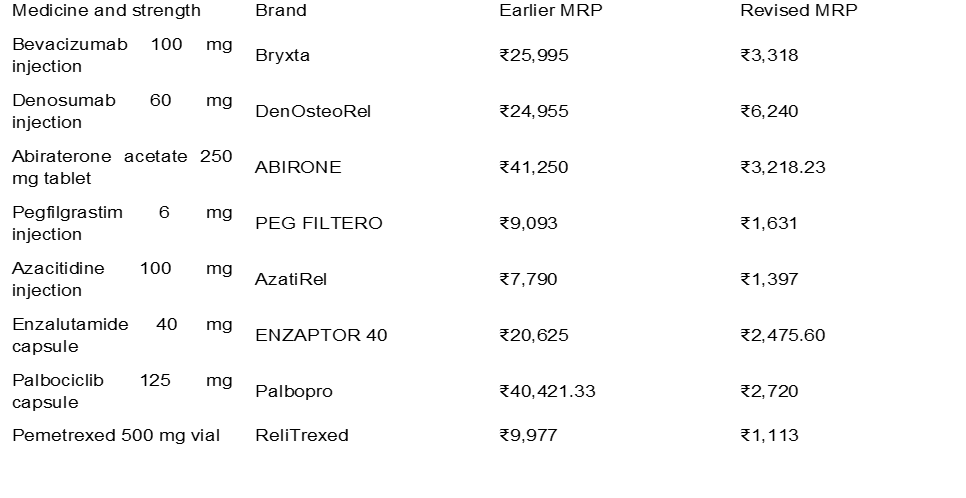
[Source: Department of Pharmaceuticals, Government of India, announcement dated 7 November 2026. Prices relate to the specified brand, strength and presentation; they are not universal prices for every brand containing the same active ingredient.]
The above figures demonstrate why trade-margin rationalization can materially affect the amount payable by patients. However, the extent of the reduction varies by brand and formulation, and the actual benefit will depend on implementation and compliance throughout the supply chain.
5. What does the 30% trade-margin cap mean?
It is important to distinguish a trade-margin cap from a uniform reduction in the MRP.
The Government has not simply ordered every affected medicine’s price to be reduced by 30 per cent. Instead, the intervention limits the applicable trade margin under the notified framework, with revised MRPs calculated and reported for individual formulations.
The resulting price reduction depends on the existing price structure of the product. Consequently, the same percentage margin restriction can produce very different reductions across brands.
The notification also requires manufacturers to comply with the applicable provisions governing subsequent annual price increases, while maintaining the prescribed maximum trade margin.
Retailers, dealers, hospitals and other institutions must display the revised price lists. State Drug Controllers are responsible for monitoring compliance by manufacturers, distributors, retailers and medical institutions.
Consumers can check revised prices through the NPPA’s official website and the Pharma Sahi Daam platform. Complaints regarding non-compliance can be made to the NPPA through its monitoring channels.
This enforcement dimension is crucial. A price-control measure will not achieve its intended purpose if the revised prices are not reflected in actual transactions or if patients continue to be charged amounts exceeding the permissible prices.
6. Is the new price cap a consequence of Supreme Court directions?
The distinction is legally significant.
The NPPA’s trade-margin rationalisation exercise was announced through the Government’s notification of 17 October 2026, based on recommendations of an expert committee constituted by the Directorate General of Health Services. It was implemented under paragraph 19 of the DPCO, 2013.
The measure should therefore be described as a Government/NPPA intervention undertaken against the background of the wider controversy over medicine pricing, rather than as a price cap imposed by the Supreme Court. The Court’s proceedings and the Government’s regulatory intervention address related concerns, but they are legally distinct developments. Without prejudice to this legal position, in my view the government’s this recent intervention may not have come through in the absence of the strong concerns expressed by the Supreme Court in the ongoing PILs.
As of the latest publicly available order dated 27 October 2026, the Supreme Court had reserved its order after concluding the hearing. Like other citizens, I am also awaiting the final judgment of the Supreme Court and may like to publish another blog to analyse the same.
As of the latest publicly available order dated 27 October 2026, the Supreme Court had reserved its order after concluding the hearing. I, like many others, await the final judgment and may publish a further analysis once it is delivered.
This distinction matters because the legal basis, scope and consequences of an executive price-control notification differ from those of a judicial direction. The notification operates under the statutory authority conferred by the DPCO, whereas the Supreme Court’s decision may address the legal and constitutional questions raised in the proceedings.
7. CCI’s failure to address alleged overcharging by in-house hospital pharmacies and the need for price transparency
Hospital pharmacy pricing presents a distinct challenge.
Hospitals may incur legitimate costs in procurement, storage, inventory management, dispensing and maintaining specialised medicines. These costs must be distinguished from unexplained or disproportionate markups.
The concern becomes particularly acute where patients are effectively required to purchase medicines from in-house pharmacies located inside the treating hospital rather than being permitted to procure them independently.
As stated in Part I of this blog, in its orders dated 21 May 2026, the CCI closed proceedings in twelve cases concerning twelve super-speciality hospitals. In my view, the Commission missed an important opportunity to examine more closely the competition-law implications of alleged overcharging, particularly the position of in-patients who may constitute a captive consumer base and may be physically or practically unable to seek alternatives for medicines and diagnostic services. The precise reasons recorded in the individual orders, however, must be kept in view; closure of proceedings is not itself a finding that the conduct was lawful.
In urgent treatment situations, patients admitted to a hospital may have neither the time nor the practical freedom to compare prices. This imbalance in bargaining power makes transparent pricing and effective oversight particularly important.
Possible measures that could be considered through appropriate regulatory action and, within its statutory remit, the CCI’s competition-advocacy function under Section 49 of the Competition Act may include:
- Clear disclosure of medicine prices and applicable discounts.
- Transparent information about clinically appropriate alternatives.
- Access to verified pricing information for medicines and medical devices.
- Effective monitoring of compliance with price-control orders by the competent authorities.
- Accessible complaint mechanisms for patients facing overcharging.
The new anti-cancer drug intervention provides a useful starting point for examining whether targeted controls, combined with better price transparency, can improve patient affordability without unnecessarily disrupting the supply of essential medicines.
8. The competition-law dimension
From a competition-law perspective, the controversy raises important questions about the limits of market-based pricing in pharmaceutical markets.
Competition can exert downward pressure on prices by allowing consumers to switch between suppliers and encouraging firms to compete on price, quality and innovation. However, several characteristics of pharmaceutical markets can weaken these mechanisms.
First, demand for life-saving medicines remains highly inelastic. A patient may have no realistic option to postpone treatment or choose a substitute.
Second, the prescribing doctor, purchasing hospital, dispensing pharmacy and ultimate patient may be different actors. The person selecting the medicine may not bear its full economic cost.
Third, patents, regulatory approval requirements, limited therapeutic alternatives and information asymmetries may constrain substitution.
Fourth, hospital procurement arrangements and restrictions on where medicines can be purchased may further limit patients’ ability to benefit from price competition.
But I must flag some important caveats.
These factors call for a careful competition-law assessment, but they do not establish that every high-priced medicine involves an abuse of dominance or an anti-competitive practice. A high price, standing alone, is not proof of a competition-law infringement. Moreover, whether competition law should at all intervene on price regulation, in a purely competitive market driven by demand and supply considerations, remains a highly debateable and moot issue.
Under Section 4 of the Competition Act, 2002, an allegation of abuse of dominance requires an assessment of dominance in the relevant market and the conduct in question. Relevant-market definition in the pharmaceutical sector can be complex. Depending on the facts, the analysis may require consideration of therapeutic substitutability based on active pharmaceutical ingredient (API), the characteristics and intended use of the drug, prescribing practices, regulatory constraints and actual competitive conditions. The analysis must also account for entry barriers and any relevant economic justification.
Similarly, substantial trade margins do not automatically establish collusion or a horizontal anti-competitive agreement, or cartel, prohibited by Section 3(3) of the Act. Such a conclusion requires evidence satisfying the applicable statutory requirements. Even in the case of a vertical arrangement under a co-marketing agreement between an originator/patent-holding company and its local generic trade partner, high trade margins, even if mutually agreed, do not by themselves establish an appreciable adverse effect on competition under Section 3(4). The arrangement must be assessed on its facts and competitive effects.
Nevertheless, I hope that in its final verdict, the Supreme Court will underscore the importance of examining whether competition functions effectively in markets where patients have limited choices and where prices may bear little relationship to the costs of distribution.
Competition enforcement and price regulation serve related but distinct purposes. Competition law addresses anti-competitive conduct and the abuse of market power; price regulation can address specified affordability concerns even where a competition-law infringement has not been established. An effective policy framework may therefore require both, alongside transparent procurement, reliable supply and measures to improve access to affordable alternatives.
9. What remains unresolved?
The intervention concerning 137 anti-cancer drugs is important, but it does not resolve every question concerning pharmaceutical pricing.
First, the measure is confined to the identified only non-scheduled anti-cancer drugs. It does not automatically extend the same trade-margin cap to all other medicines.
Second, the actual savings to patients will depend on compliance, monitoring and the prices charged in practice.
Third, questions remain about the treatment of high initial prices, the selection of medicines for scheduled price control and the extent to which targeted intervention should be used in other therapeutic categories.
Fourth, hospital pharmacy practices , including brand preferences by doctors , over charging by In house pharmacies and patients’ ability to obtain medicines independently may require separate attention.
Finally, any expansion of price controls must consider the availability of medicines, incentives for innovation, the risk of shortages and the sustainability of supply.
The Supreme Court’s forthcoming decision may clarify aspects of the legal framework and the Government’s responsibilities, but its precise implications cannot be predicted before the judgment is delivered.
Conclusion
The Supreme Court’s scrutiny of medicine pricing and the NPPA’s recent intervention have brought an important public-policy issue into focus: how can India ensure that the benefits of a large pharmaceutical industry translate into affordable treatment for its citizens?
The answer cannot lie in treating every medicine as an ordinary commodity, leaving its price entirely to market forces. Equally, it need not lie in subjecting every medicine to identical price controls. A sound regulatory framework must distinguish legitimate commercial returns from excessive pricing, encourage competition where it can function effectively, and provide targeted intervention where patients lack meaningful alternatives.
The Government’s decision to rationalise trade margins for 137 non-scheduled anti-cancer drugs is a significant step. The reported reductions in MRPs demonstrate the potential of targeted regulatory intervention. Its ultimate success, however, will depend upon effective implementation, monitoring and whether the reported reductions translate into actual savings for patients. The Supreme Court’s forthcoming judgment may provide further clarity on the Government’s obligations and the broader framework governing medicine pricing.
But the debate must not end with price caps. It must also address the structural features and business practices that can undermine effective competition in the pharmaceutical sector, including brand proliferation, potentially restrictive co-marketing arrangements and pay-for-delay agreements. Equally disturbing are other blatant, human greed-based practices, such as “cuts and commissions” paid to doctors for promoting favoured brands, fee-splitting arrangements involving doctors and diagnostic establishments, inducements to prescribe favored brands or unnecessary medical devices and implants, and unnecessary diagnostic investigations. These practices call for effective scrutiny by the appropriate competition, regulatory and enforcement authorities.
There is also an urgent need to strengthen the law governing the medical profession. The erstwhile sector regulator, the Medical Council of India (MCI), which prescribed the voluntary Code of professional conduct, etiquettes and ethical medical practice since 2002[1] (“Code”), remained a toothless tiger on paper. Though the Indian Medical Council (Professional Conduct, Etiquette and Ethics) Regulations, 2002, continue to remain operative under the National Medical Commission Act, 2019, prescribe binding standards of professional conduct, yet, the persistence of practices that appear inconsistent with those standards raises serious questions about the effectiveness of their enforcement. A code of professional ethics, however comprehensive, serves little purpose if violations do not attract timely and meaningful accountability.
Ultimately, affordable healthcare cannot be secured by any one institution or regulatory intervention. It requires coordinated action by the Government, NPPA, CCI, NMC and other relevant authorities. Price regulation, competition enforcement and professional accountability must operate as complementary instruments.
The larger objective should be a healthcare system in which medicines remain available, innovation is encouraged and legitimate commercial activity is sustainable, while the cost of indispensable treatment does not become an insurmountable barrier for patients. The real test of India’s regulatory framework will not be the number of laws, codes or price-control notifications it adopts, but whether they translate into affordable treatment, ethical medical practice and meaningful protection for patients.
#AffordableHealthcare #MedicineAffordability #PublicHealth #HealthcarePolicy #MedicalEthics #PatientSafety #NPPA #NationalMedicalCommission #ConsumerProtection #India
#CompetitionLaw #CCI #Antitrust #PharmaLaw
#PharmaceuticalIndustry #DrugPricing #HealthcareRegulation
#AccessToMedicines #PatientRights
Sources and notes
1. Media reports on the Supreme Court proceedings: India Today; LiveLaw; NDTV; The Economic Times (links reproduced in the original draft).
2. Department of Pharmaceuticals, Government of India, press release on trade-margin rationalisation for 137 anti-cancer drugs (PRID=2324743):
https://www.pib.gov.in/PressReleasePage.aspx?PRID=2324743&lang=1®=3
3. NPPA revised prices portal:
https://www.nppa.gov.in/en/revised-prices
4. National Medical Commission notification dated 23 August 2023 holding the 2023 Professional Conduct Regulations in abeyance and adopting the 2002 Regulations:
https://egazette.gov.in/WriteReadData/2023/247951.pdf
5. Yash Charitable Trust & Ors. v. Union of India & Ors., W.P. (C) No. 369 of 2022, 2026 INSC 96, decided on 30 January 2026.
[1] The Professional Conduct, Etiquette and Ethics Regulation ,2002 published by Medical Council of India vide Gezzette Notification dated 11 March 2002.